THE SCENARIO
A bank has a delivery problem, and it can't hire its way out of it.
Picture a Tier 1 bank, one of the continent's largest institutions, facing a familiar paradox. Its transformation agenda was growing, regulatory mandates continued to accumulate, and customer expectations, shaped by fintechs and neobanks, were shifting fast. And yet, its technology team was stretched thin, caught between keeping current systems operational and building the bank of tomorrow.
The bank had tried the obvious answer: hire more people. But skilled engineers took months to onboard. Permanent headcount carried fixed cost regardless of project cycles, and core delivery kept slipping. Effort was never the issue; rather, the operating model was never designed for this required speed.
The challenge was structural, more than a simple shortage of skills.
THE COMPLICATION
The market has changed, but the operating model hasn't
At a recent Resource Augmentation as a Service Roundtable hosted by FinSense Africa, leaders from banking, media, and adjacent industries surfaced a clear pattern: the traditional build-it-all-internally model had hit its ceiling.

Resource augmentation was the first answer; bring in contractors to bridge skill or capacity gaps while keeping full control. It worked, to a point. But it still placed the burden of coordination, management, and delivery accountability squarely on the bank's internal teams. Leaders were augmenting, yet they weren't seeing a corresponding increase in delivery speed.
When a business makes promises to customers and shareholders, IT is expected to deliver. The question is no longer whether to use external partners; it's whether they're set up to truly share accountability for outcomes.
Meanwhile, transformation agendas were only growing larger. The gap between what technology teams were being asked to deliver and what they could realistically execute was widening, not because of a lack of effort, but because the model itself was a bottleneck.
THE SOLUTION
The answer wasn't more people. It was a different kind of partnership.
The institutions leading the conversation had arrived at a different model: instead of augmenting teams piecemeal, they were outsourcing specific projects, workstreams, and outcomes to trusted delivery partners. These partners bring people, structure, accountability, and measurable results, all in a single package
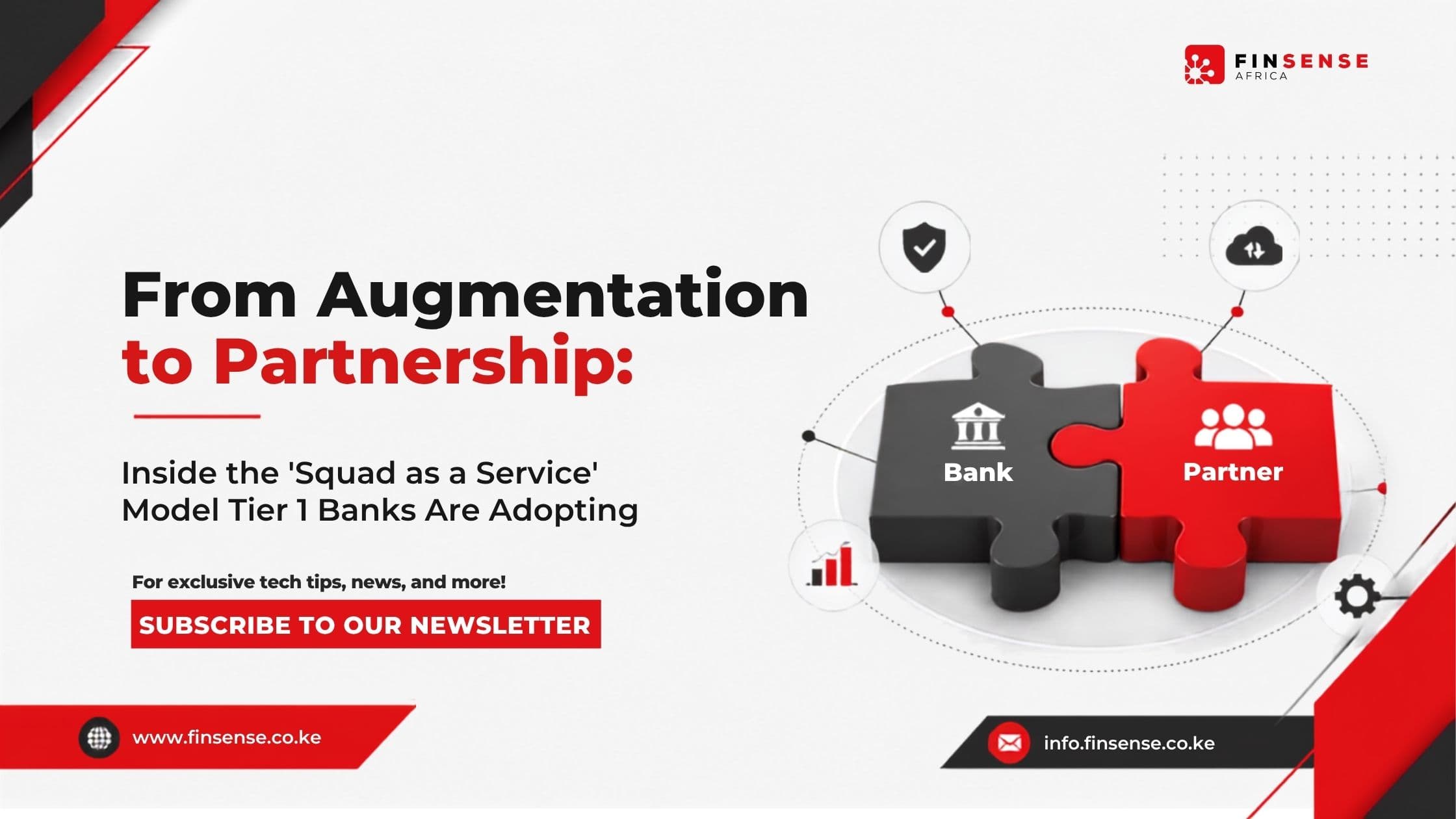
FinSense Africa calls this Squad as a Service. The idea is precise: a named squad with defined scope, agreed milestones, and clear ownership. This is not a pool of contractors you manage yourself, but a delivery unit that shares accountability for what gets built.
What this model unlocks:
Internal teams are freed to focus on core strategic priorities
Faster execution on transformation workstreams
Outcome accountability is built into the engagement model
External partners are treated as part of the delivery ecosystem
The framing matters. This is not outsourcing as a loss of control, but rather outsourcing as a strategic choice. It allows internal teams to concentrate on what only they can do, while trusted partners own specific delivery lanes with full transparency and governance.
SOMETHING TO KEEP IN MIND
Risk, Regulation and the Governance Imperative
No conversation in financial services about operating model change escapes one immovable reality: the regulator is always in the room. Tier 1 banks cannot simply optimize for speed. They operate in one of the most scrutinized environments on earth, and any change to how they deliver technology must survive regulatory review.

The roundtable discussion was frank about this tension — and equally frank about the false choice it presents. Banks and regulators are not adversaries in this conversation. Both want the same outcome: systems that work, resilient institutions, and customers who can trust the infrastructure they depend on.
The challenge is building delivery models mature enough to satisfy that shared goal without grinding innovation to a halt. That means governance frameworks that can travel with the engagement, rather than being bolted on afterward. It means third-party risk management that is proactive, not reactive. And it means regulators who are brought into the conversation early, not presented with a fait accompli.
The future is not about avoiding risk entirely. It is about building mature governance, trusted partnerships, and operational models that allow institutions to move with both confidence and speed.
WHY THIS MATTERS
There are 3 things leading banks are doing differently;
They've stopped treating external partners as temporary.
The most capable banks have redefined what "the team" means. External squads are embedded into delivery rhythms, sprint cadences, and accountability structures — not held at arm's length as vendors.
They've built governance before they needed it.
Risk and compliance frameworks for third-party delivery are designed upfront, not retrofitted. This accelerates regulatory comfort and prevents delivery from stalling mid-stream.
They've shifted the conversation from cost to outcome.
The right question is no longer "how much does this resource cost per month?" It is "what does this partner own, and how do we measure whether they delivered it?"
Conclusion
The Tier 1 banks that will win the next decade of transformation are not those with the largest internal teams. They are those with the most capable ecosystems: institutions that know what to own, what to partner on, and how to hold everyone accountable for results. The model is changing. The institutions that adapt earliest will carry the greatest advantage.
#banking #technology #squadasaservice #resourceaugmentation #regulation #fintech #FinSenseAfrica